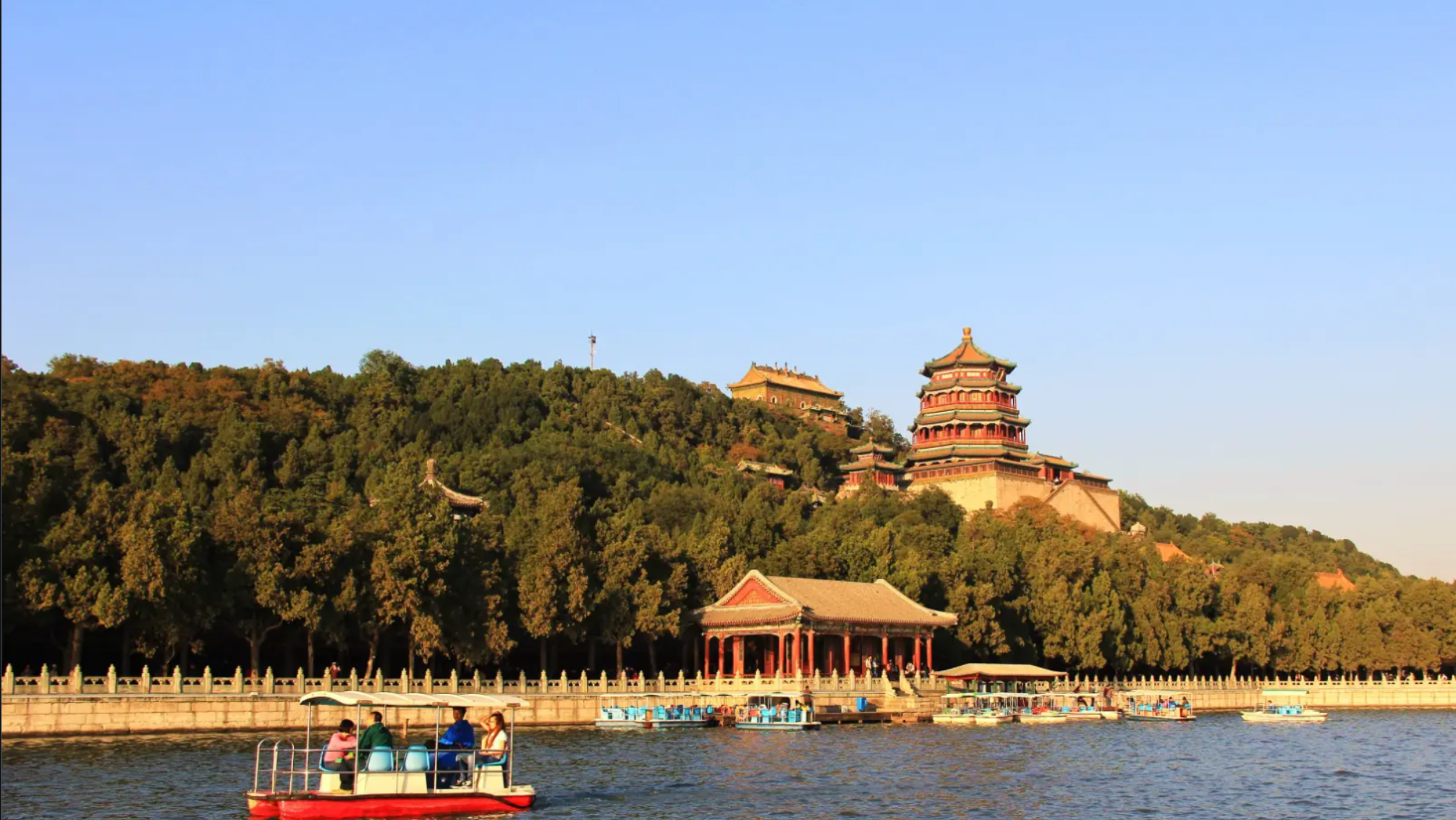

The Summer Palace, a former Qing Dynasty imperial garden originally named the Garden of Clear Ripples (Qingyi Yuan), is located at 19 Xinjiangongmen Road, Haidian District, in the western suburbs of Beijing. The garden is built on the base of Longevity Hill and Kunming Lake, drawing design inspiration from the landscape of Hangzhou's West Lake and incorporating the artistic techniques of Jiangnan-style gardens. It is a vast natural landscape garden and the most completely preserved imperial palace-garden complex, renowned as the "Royal Garden Museum." Covering an area of 3.009 square kilometers, water surfaces account for about three-quarters of the total area, which is composed of Longevity Hill and Kunming Lake. The garden contains over 100 scenic structures, more than 20 large and small courtyards, and some 3,000 ancient architectural spaces with a combined floor area of nearly 70,000 square meters, alongside 1,600 ancient and famous trees .
The Summer Palace was first constructed in 1750, the 15th year of Emperor Qianlong's reign. It was burned down by the Anglo-French Allied Forces in 1860 . Reconstruction began in 1886 using funds misappropriated from the imperial navy, among other sources, and it was renamed "Yihe Yuan" (The Garden of Health and Harmony) two years later, serving as a summer resort for Empress Dowager Cixi . The garden suffered damage again in 1900 by the Allied Forces of the Eight Powers and was restored in 1902 .
The most prominent feature of the Summer Palace lies in the perfect harmony between its natural landscape of hills and water and its grand imperial architectural complexes. The scenic design within the genuine mountains and water bodies emphasizes both imperial magnificence and a harmonious unity between the garden and its natural setting. It draws from nature yet surpasses it, skillfully blending natural beauty with artificial craftsmanship . The garden's landscaping integrates the artistic concepts of Chinese painting, poetry, and literature, creating a composition marked by grand scale, splendid colors, and full coordination with the surrounding landscape and greenery. The Summer Palace houses a collection of more than 40,000 cultural relics, covering almost all categories of Chinese heritage artifacts, including over 20,000 pieces designated as National-Level Cultural Objects .
On March 4, 1961, the Summer Palace was announced by the State Council of the People's Republic of China as one of the first group of Major Historical and Cultural Sites Protected at the National Level . In December 1998, it was inscribed by UNESCO on the World Heritage List, which recognizes it as "an outstanding expression of the creative art of Chinese landscape garden design, incorporating the works of humankind and nature in a harmonious whole" .