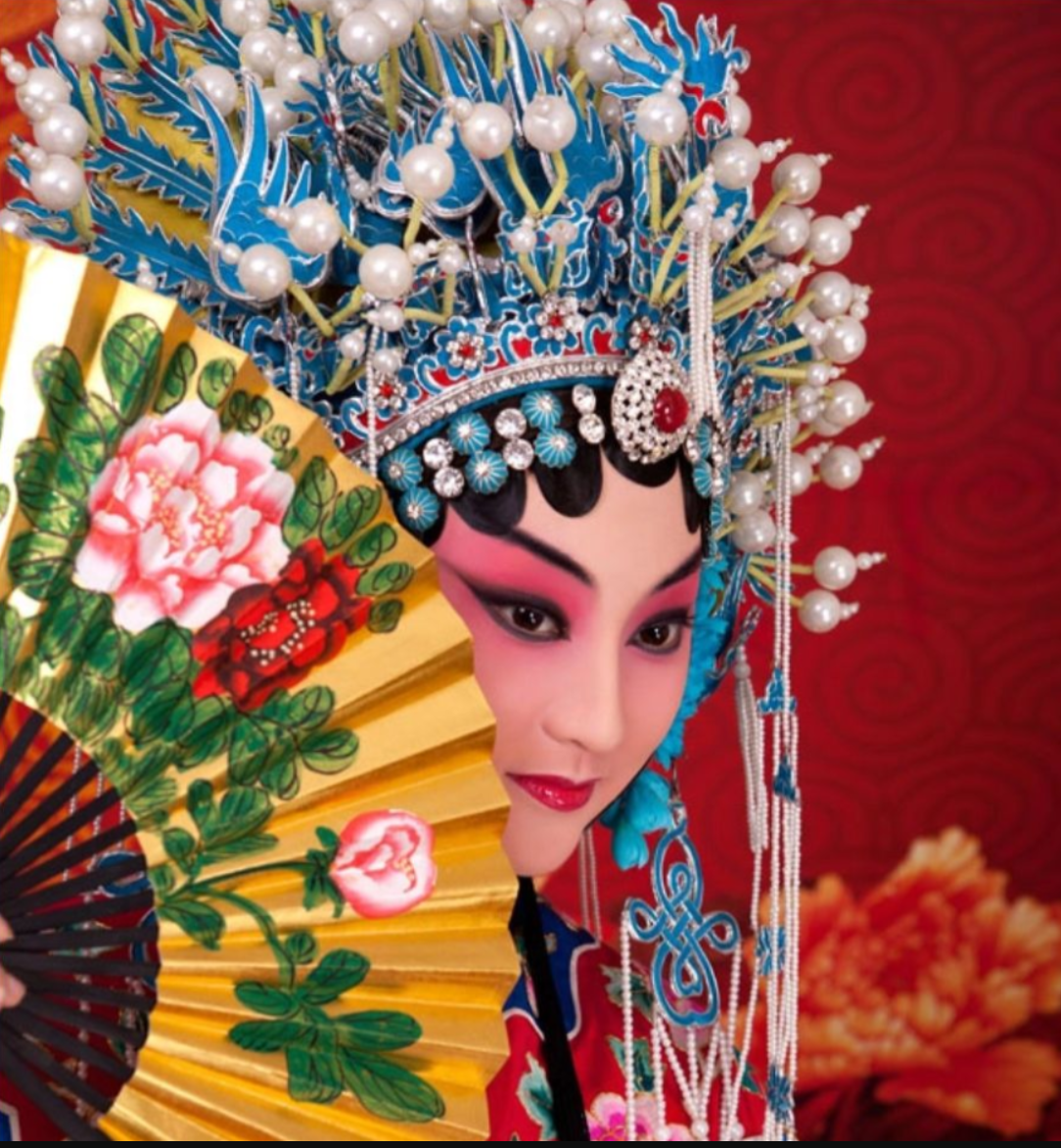

Peking Opera (also known as Beijing Opera or Jingju), recognized as one of China's cultural treasures, is the most influential form of traditional Chinese theatre. While its distribution centers on Beijing, it is practiced throughout the country .Its formation dates back to the 55th year of the Qianlong Emperor's reign in the Qing Dynasty (1790), when the Four Great Anhui Troupes—Sanqing, Sixi, Chuntai, and Hechun—originally based in southern China, successively entered Beijing. They collaborated with performers of the Han opera from Hubei Province, creating a performance structure described as "troupes are Hui troupes, tunes are Han tunes" . This foundation was further enriched by incorporating elements from Kunqu Opera, Qinqiang (Shaanxi opera), and various local folk melodies. Through continuous exchange and integration, Peking Opera evolved, characterized by its dominant Xipi and Erhuang musical modes, and a delivery that blends Beijing and Han linguistic features with Huguang pronunciation and Zhongzhou rhymes .
Peking Opera features a highly standardized artistic expression in literature, performance, music, and stage art. Its vocal music follows a banqiang ti (metrical and melodic structure) system. The accompaniment is divided into the civil ensemble (wénchǎng), which features the Jinghu(a two-stringed fiddle) as the lead instrument, and the military ensemble (wǔchǎng), which is primarily comprised of percussion instruments like drums, gongs, and cymbals .
The roles in Peking Opera are categorized into Sheng (male roles), Dan (female roles), Jing (painted-face roles), and Chou (clowns). Each category has further subdivisions. Every role type has its own set of performance conventions, and the skills of singing, recitation, acting, and acrobatic combat are each distinct . With a repertoire of over 1,300 traditional pieces based largely on historical stories, several hundred are performed regularly .
Having spread across China with profound influence, Peking Opera is honored as the "National Opera". The performance system named after Mei Lanfang is regarded as a representative of Eastern theatrical art and is considered one of the world's three major performance systems . As an essential vehicle for traditional Chinese culture, many of its artistic elements serve as symbolic representations of China's heritage.
Peking Opera was inscribed on China's first national list of intangible cultural heritage in 2006 and was listed by UNESCO as an Intangible Cultural Heritage of Humanity in 2010 .