

Centered on the theme of Geological Records of Paleoanthropic Living Environments and Sedimentary Processes in Karst Caves, this route links visits to paleoanthropic sites with karst cave investigations. It demonstrates the dual value of the Zhoukoudian area as the "cradle of geological science" and the "holy land of human evolution". Meanwhile, through the rich and colorful speleothems in Shihua Cave, it reveals the scientific connotations of groundwater geochemical processes and paleoclimatic reconstruction. The route caters to the academic interests and experiential needs of geologists and geochemists in Quaternary geology, paleoenvironmental reconstruction and karst geochemistry.
1. Core Orientation and Design Philosophy
Academic Theme: Geochemical characteristics of speleothems and paleoenvironmental reconstruction; karst development processes and genetic mechanisms of speleothems; geological background of paleoanthropic activities and site protection.
Design Logic: From "ancient human site visit (fossils and fire use evidence) → cave geochemistry interpretation (dripwater deposition process and stalagmite paleoclimate records) → karst landform observation (cave development and secondary chemical deposits)", constructing an integrated geology-archaeology-geochemistry excursion.
Target Participants: International applied geochemists, Quaternary geologists, paleoanthropology and archaeology researchers, with a balance of professional depth and natural landscape experience.
2. Information Distribution Instructions
Pre-symposium Distribution: Excursion route introduction manual (including the geological map of the Zhoukoudian area, stratigraphic column of the Peking Man Site, cave development profile of Shihua Cave, geological background notes of key observation sites), excursion site map, and notes for attention.
On the bus: Participants may read relevant materials in advance; no centralized academic introductory lectures will be arranged during the itinerary.
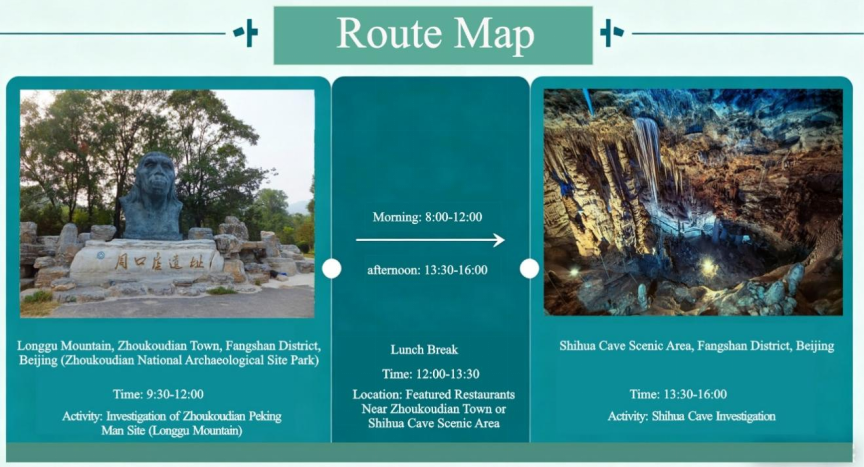
3. Detailed Itinerary (08:00-18:00)
l 08:00 Assembly and Departure from Beijing
Assembly Location: Symposium venue or designated hotel
Transportation: Luxury air-conditioned coach with over 35 seats, equipped with on-board WiFi and charging ports
Note: No academic lectures will be arranged during the ride; participants may review the pre-distributed materials.
l 09:30-12:00 Investigation of Zhoukoudian Peking Man Site (Longgu Mountain)
Location: Longgu Mountain, Zhoukoudian Town, Fangshan District, Beijing (Zhoukoudian National Archaeological Site Park)
Format: Guided and explained by a professional geological/archaeological guide for the entire session, with all participants acting in a group.
Core Investigation Content:
· Peking Man Cave (Locality 1)
Field observation of the Peking Man fossil locality and understanding of the stratigraphy of cave deposits. The cave deposits at Locality 1 of Zhoukoudian are more than 40 meters thick and can be divided into 17 layers, consisting of alternating breccia layers and non-breccia layers (ash layers, argillaceous sand layers, stalactite layers, etc.). These stratigraphic sequences record multiple cold-warm climate fluctuations in the Zhoukoudian area since the Middle Pleistocene—breccia layers represent glacial/cold periods, and non-breccia layers represent interglacial/warm periods. For geochemists, the geochemical characteristics (e.g., element contents, isotopic compositions) of sediments in different layers can directly reflect the process of paleoenvironmental evolution.
· Geochemical evidence of fire use remains
Visit the layers with fire use remains discovered in the Peking Man Cave and learn about the latest research results on the controlled use of fire by Peking Man. Studies have shown that the magnetic susceptibility of sediments in some suspected fire-use areas at the site is 22 times higher than that in other areas, and the chroma is nearly 3 times higher. It is inferred from this that the sediments most likely experienced high-temperature heating above 700℃—while natural fires generally do not exceed 300℃. This discovery provides important geochemical evidence for the controlled use of fire by humans, and also demonstrates the application value of indicators such as magnetic susceptibility and chroma in archaeological research.
· Upper Cave and other caves
Visit late paleoanthropic sites such as the Upper Cave and understand the living environments of late Pleistocene paleoanthropes and paleontological organisms. Geochemical indicators such as trace element distribution and organic matter content in cave sediments can provide important information for reconstructing paleoanthropic living environments.
· Visit to the Site Museum
Visit the Zhoukoudian Site Museum to learn about the discovery history of the site, the academic value of the Peking Man skull fossils, and the important progress made in interdisciplinary research (geology, geochemistry, paleontology) in recent years. The cave deposit stratigraphic section models and paleontological fossil specimens displayed in the museum can complement field observations.
Guiding Support: The geological guide will explain on site the stratigraphic significance of cave deposits, geochemical identification methods of fire use remains, and the connection between the geological background of the site area and the paleoanthropic living environment.
Participants may visit the museum and purchase souvenirs at their own discretion.
l 12:00-13:30 Lunch near Zhoukoudian Town or Shihua Cave
Location: Featured Restaurants Near Zhoukoudian Town or Shihua Cave Scenic Area
Catering: Chinese set meal (including local specialties), taking into account the dietary habits of international participants.
l 13:30-16:00 Investigation of Shihua Cave
Location: Shihua Cave Scenic Area, Fangshan District, Beijing (approximately 20-30 minutes' drive from the Zhoukoudian Peking Man Site)
Format: Guided and explained by a professional geological guide for the entire session, with all participants acting in a group and visiting on foot inside the cave.
Core Investigation Content:
· Cave development and stratigraphic control
Shihua Cave develops in the limestone of the Majiagou Formation of the Middle Ordovician, with a total of seven cave layers, covering almost all morphological types of karst cave speleothems. The purity and thickness of Ordovician limestone provide a good material foundation for cave development, while tectonic uplift since the Yanshan Movement has controlled the vertical layered characteristics of the cave.
· Types and genetic mechanisms of cave speleothems
Observe a variety of secondary speleothems inside the cave, including:
o Drip water deposits: Stalactites, stalagmites, stone pillars—formed by CO₂ degassing and CaCO₃ supersaturation precipitation during the dripping of gravitational water from the cave ceiling.
o Flowing water deposits: Stone curtains, stone waterfalls, stone shields—formed by the deposition of water flowing along cave walls or inclined surfaces.
o Capillary water/non-gravitational water deposits: Stone flowers, stone branches, helictites, soda straws—formed by evaporation and concentration of film water and capillary water in microfractures of the cave.
o Fog water deposits: Stone flowers, stone grapes—formed by condensed water deposition in the high-humidity environment inside the cave.
Shihua Cave is famous for its "stone flowers", and its calcite crystal clusters known as "flaming trees and silver flowers" are typical representatives formed by capillary seepage water, with exquisite morphologies. For geochemists, the formation conditions of such deposits (humidity > 98%, still air) reflect the fine control of the cave microenvironment.
· Stalagmites and paleoclimatic reconstruction
Understand the application value of stalagmites as a "millennial thermometer" in Quaternary paleoenvironmental research. The growth rate, stable isotopic compositions (δ¹⁸O, δ¹³C) and trace element ratios (Mg/Ca, Sr/Ca) of stalagmites can record changes in paleotemperature and paleoprecipitation. Long-term monitoring of drip water geochemistry in Shihua Cave shows that cave drip water is mainly derived from summer precipitation, and its chemical composition (Ca²⁺, Mg²⁺, SO₄²⁻, etc.) is jointly controlled by overlying soil processes and atmospheric precipitation, providing a modern process basis for the paleoclimatic interpretation of stalagmites.
· Cave environment and geochemical processes
The constant temperature (about 13-15℃) and high humidity environment inside the cave provide conditions for the continuous growth of secondary speleothems. For geochemists, Shihua Cave is a natural "laboratory" that demonstrates the chemical kinetic processes of carbonate dissolution and precipitation, the equilibrium control of the CO₂-H₂O-CaCO₃ system, and the partitioning behavior of trace elements at the solid-liquid interface.
Guiding Support: The geological guide will explain on site the formation mechanisms of various cave speleothems, the principles of stalagmite paleoclimatic reconstruction, and the cutting-edge issues in cave geochemistry research.
Participants may visit the supporting facilities of the scenic area and purchase souvenirs at their own discretion.
l 16:00-18:00 Return to Beijing
Transportation: Luxury coach will send all participants back to the symposium venue/designated hotel in Beijing uniformly.
On the way: Excursion souvenir gift packs (including geological atlases of the Zhoukoudian area, popular science manuals of Shihua Cave, site souvenirs, etc.) may be distributed.
4. Highlights of the Itinerary
In-depth integration of human evolution and geochemistry: The morning visit to the Zhoukoudian Peking Man Site presents professional content such as magnetic susceptibility anomalies of fire use remains and geochemical records of cave deposits, demonstrating the unique value of geochemical methods in archaeological research and allowing international scholars to experience the profound connection between "geology and human civilization".
Natural laboratory for cave geochemistry: The afternoon investigation of Shihua Cave involves observing almost all types of cave speleothems, from drip water deposits to non-gravitational water deposits, from stalagmite laminae to paleoclimatic reconstruction, providing an intuitive teaching scene for researchers in karst geochemistry and Quaternary geology.
Relaxed and comfortable rhythm: The whole journey focuses on observation and experience, without sampling, group division, special lectures and other sessions, reducing the physical burden on participants, and is suitable for a relaxing excursion during the academic symposium.
Geological theme throughout: From the cave deposit stratigraphy of the paleoanthropic site to the carbonate karst dissolution-precipitation process of Shihua Cave, from the geochemical identification of fire use remains to the paleoclimatic records of stalagmites, the main line of geochemistry and geology runs through the whole day, enhancing the interest of the excursion while maintaining professional attributes.
International comparison value: As a world cultural heritage, the Zhoukoudian Peking Man Site enjoys a high reputation in the global field of paleoanthropology research; Shihua Cave has a complete range and well-preserved cave speleothems, which can be compared with karst caves in Europe, North America and other regions, and has international academic exchange value.