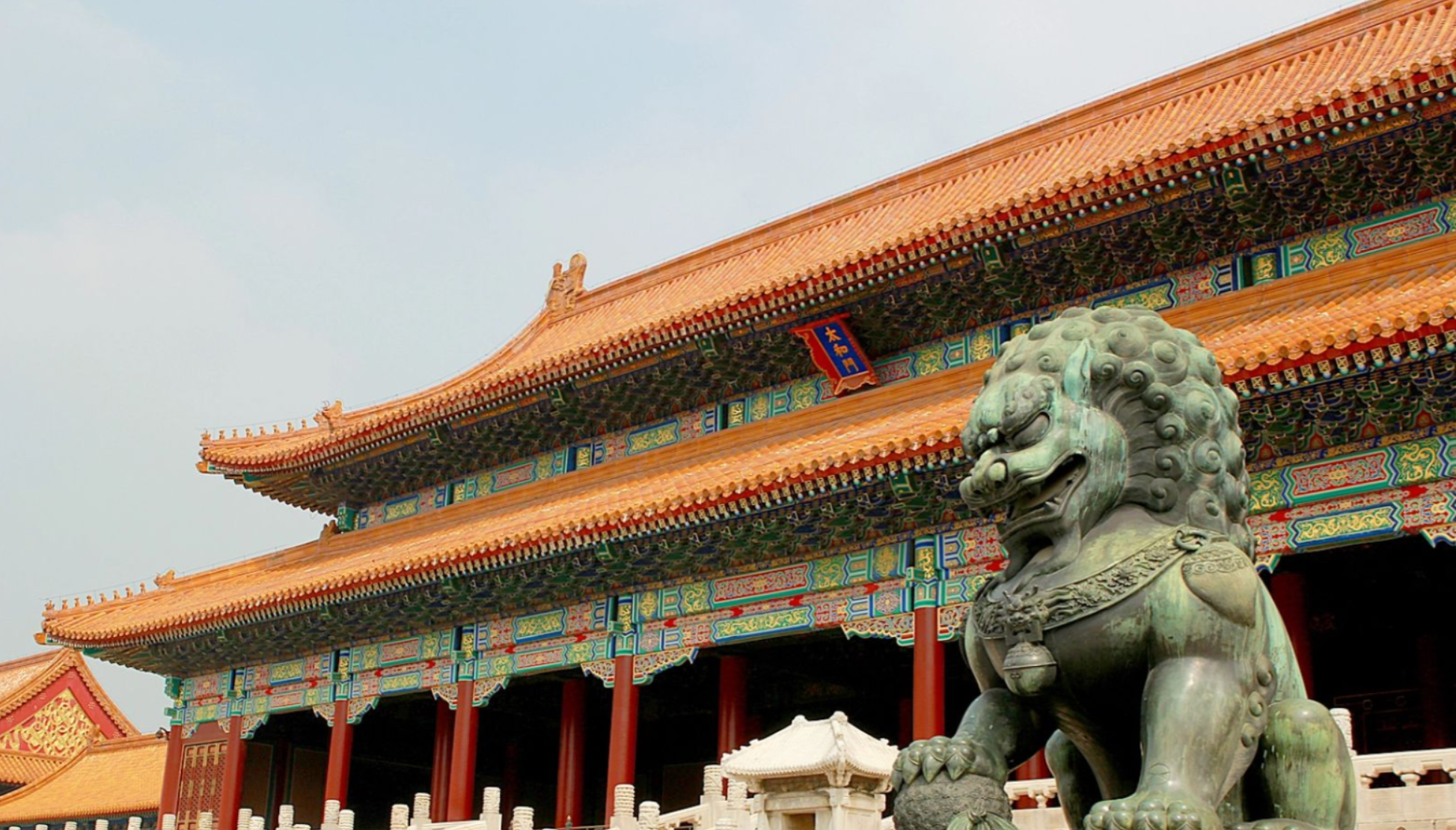

The Imperial Palace, also known as the Forbidden City, located in Beijing, China, was the imperial palace of the Ming and Qing dynasties. Situated at the center of Beijing's Central Axis, it covers an area of approximately 720,000 square meters, with a floor space of about 150,000 square meters. Centered around the Three Great Halls, it comprises over 70 palaces and courtyards. Traditionally said to have 9,999.5 rooms, a 1973 survey determined the actual number to be 8,707 rooms .
Construction of the Imperial Palace began in 1406, the fourth year of the Yongle reign of the Ming Dynasty, modeled after the Nanjing Imperial Palace. It was completed in 1420 and served as the palace for 24 emperors throughout the Ming and Qing dynasties. On October 10, 1925, the Palace Museum was officially inaugurated . The palace complex measures 961 meters from north to south and 753 meters from east to west, surrounded by 10-meter-high walls and a 52-meter-wide moat . It has four main gates: the Meridian Gate (Wu men) to the south, the Gate of Divine Prowess (Shenwu men) to the north, the East Glorious Gate (Donghua men) to the east, and the West Glorious Gate (Xihua men) to the west. At each of the four corners of the wall stands an exquisitely designed corner tower, whose complex structure is described by the folk saying "nine beams, eighteen pillars, and seventy-two ridges" .
The architecture within the Imperial Palace is divided into two main sections: the Outer Court and the Inner Court . The Outer Court, centered on the Three Great Halls—the Hall of Supreme Harmony (Taihe dian), the Hall of Central Harmony (Zhonghe dian), and the Hall of Preserving Harmony (Baohe dian)—was the venue for major state ceremonies . Flanking the Three Great Halls are the Hall of Literary Glory (Wenhua dian) and the Hall of Martial Valor (Wuying dian). The Inner Court is centered on the Three Rear Palaces—the Palace of Heavenly Purity (Qianqing gong), the Hall of Union (Jiaotai dian), and the Palace of Earthly Tranquility (Kunning gong)—which served as the living quarters for the emperor and empress . Behind these lies the Imperial Garden. To the sides of the Three Rear Palaces are the Eastern and Western Six Palaces, which were the living quarters for the imperial concubines. To the east of the Eastern Six Palaces are Buddhist halls such as the Hall of Celestial Favor (Tianqiong baodian), while to the west of the Western Six Palaces are halls like the Hall of Central Uprightness (Zhongzheng dian). Beyond the Outer Court and Inner Court are additional sections known as the Outer Eastern Route and Outer Western Route .
The Imperial Palace is one of the world's largest and best-preserved ancient wooden structural complexes . On March 4, 1961, it was designated as one of the first Major Historical and Cultural Sites Protected at the National Level in China. In 1987, it was inscribed on the UNESCO World Heritage List .